 18+
18+
18+
18+
From bankroll fundamentals to bonus floor tactics — a complete, balanced strategy playbook for Tower Rush players who want consistent results.
Free demo — no real money. Mirrors the real game's behaviour. May be unavailable in some regions.
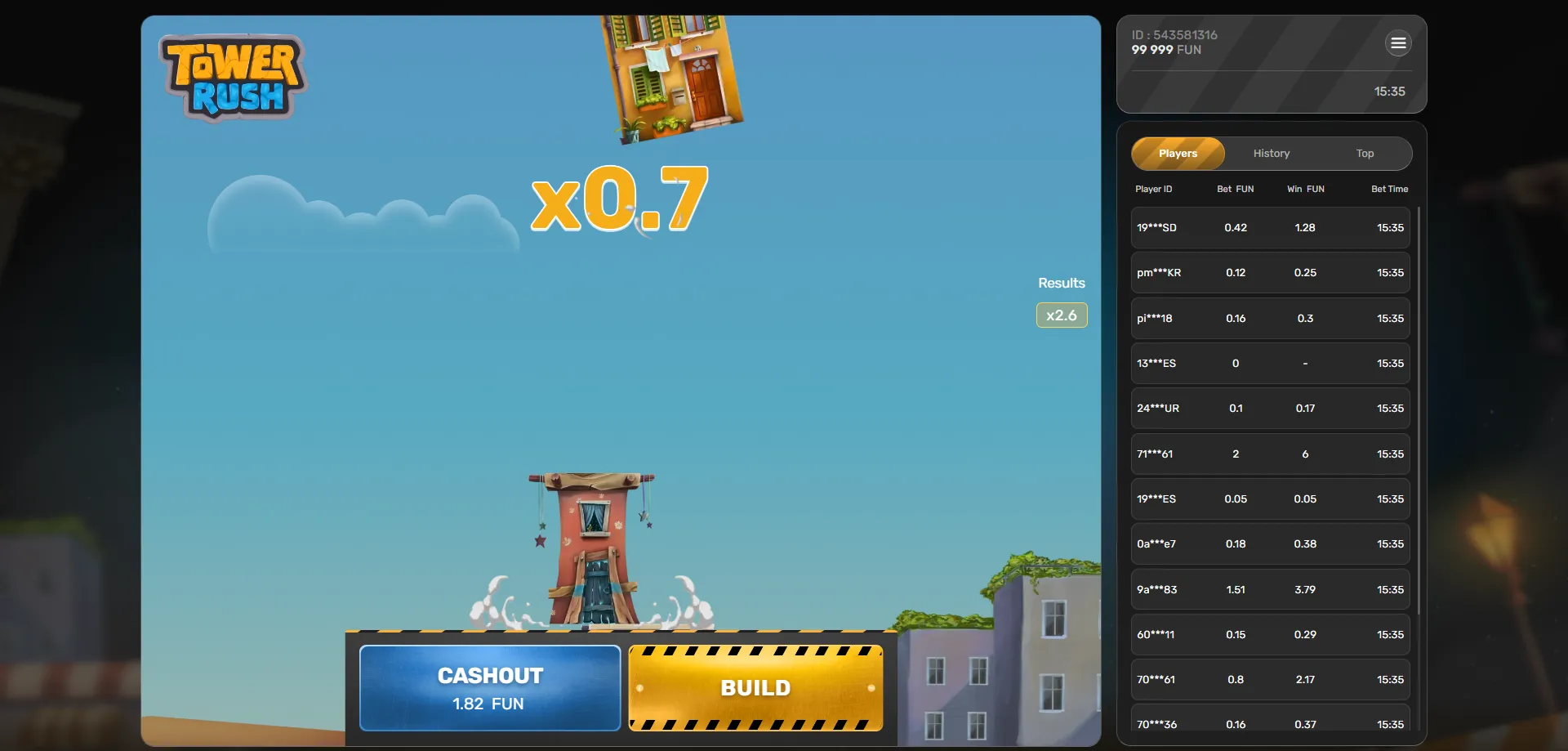
Tower Rush combines a deceptively simple mechanic — stack floors, watch the multiplier climb, cash out before the collapse — with genuine depth that rewards players who approach each session with a plan. Understanding why tower rush strategy matters begins with recognising the difference between playing instinctively and playing systematically.
Every round in Tower Rush is governed by a certified Random Number Generator, meaning no individual outcome can be predicted. What a strategic mindset does is not predict results — it manages probability over dozens of sessions. A lucky player might hit a 50x multiplier on their first attempt and walk away ahead. A strategic player, by contrast, sets clear exit targets and bankroll rules that protect their balance whether they are running hot or cold. Over time, discipline outperforms variance.
The distinction matters especially in a turbo-crash format where rounds last only seconds. The speed of play can compress hundreds of decisions into a single hour, amplifying both good habits and bad ones. Players who have internalised a plan before they sit down are far less likely to chase losses or overstay a lucky streak.
You cannot control when the tower collapses. You can control your bet size, your cash-out target, the number of rounds you play per session, and whether you use available features like the Frozen Floor to lock in partial gains. These controllable variables are the entire foundation of any viable tower rush strategy. Everything else is variance, and variance is the opponent you are managing — not fighting.
Before placing a single bet, a prepared player has already made several key decisions. The most important concern the game's mathematical profile and how to read its payout structure honestly.
Tower Rush carries an exceptional RTP of 98.50% — significantly higher than the 96% industry average for most online slots and crash games. In practical terms, this means that for every 100 units wagered over a long session, the game is mathematically designed to return approximately 98.50 units. That narrow house edge gives players more runway to apply a consistent strategy compared with lower-RTP alternatives.
Pair that with medium volatility and you have a game that produces a steady flow of small-to-medium multipliers, punctuated by occasional larger climbs. The tactical implication is clear: medium-volatility play suits a patient, disciplined cash-out approach rather than swinging for maximum multipliers every round. Aim for the middle range — multipliers between 1.5x and 3x — and let the high RTP do its work across volume.
Because Tower Rush uses dynamic multipliers rather than a fixed paytable, understanding the payout structure means understanding how multipliers accumulate. Each successfully placed floor adds to your current multiplier, and three special bonus floors — Frozen Floor (1.5x–7x), Temple Floor (bonus wheel with up to 7x), and Triple Build (three guaranteed extra floors) — can accelerate gains unexpectedly. Before starting a real-money session, spend time in the free demo mode observing how frequently these bonus floors appear and at what tower heights. This gives you calibrated expectations rather than optimistic assumptions.
No amount of clever bet timing compensates for poor bankroll management. This section covers the two structural rules that separate players who survive long sessions from those who bust early.
The fixed percentage method is the most transferable tower rush tips and tricks principle because it scales with your actual balance. The rule is straightforward: never wager more than 1–2% of your total session bankroll on a single round. If you deposit 500 units, your per-round stake is 5–10 units. This approach ensures that a losing streak of 10 consecutive rounds — perfectly plausible given medium volatility — still leaves roughly 80–90% of your bankroll intact for recovery.
Resist the temptation to increase the percentage after wins. The moment you treat winnings as bonus risk capital rather than real money, the fixed percentage stops working. Recalculate your stake against the new total balance periodically, but keep the percentage constant.
A session limit defines how long or how much you will play before stopping regardless of results. A loss limit defines the maximum drawdown you will accept before closing the game. Practical benchmarks for Tower Rush, given its medium volatility and high RTP: set a loss limit at 20–25% of your session bankroll, and a win target at 30–40%. If either threshold is hit, the session ends — no exceptions.
The discipline to honour these limits is, genuinely, the most valuable tower rush lifehack available. It costs nothing to implement, requires no special knowledge, and prevents the single biggest reason recreational players lose more than the mathematics would predict: extended play beyond the point where clear thinking is still operating.
Once your bankroll framework is in place, the next layer of strategy concerns how you vary — or deliberately do not vary — your bet size across rounds.
Flat betting means placing the same stake on every round without adjustment. It is the most conservative approach and the one most aligned with Tower Rush's medium-volatility profile. With a constant stake, variance is smoothed across a larger number of rounds, and the game's 98.50% RTP has the most room to express itself. Flat betting works best for players with a moderate bankroll who want long, controlled sessions rather than dramatic swings.
The psychological advantage is underrated: when your stake never changes, there is no arithmetic stress mid-session. You simply apply your cash-out rule consistently and let results accumulate.
A mild positive progression — increasing your stake slightly after a win and returning to base after a loss — can amplify profitable streaks without catastrophically compounding losses. A common implementation is to increase your stake by 25–50% following two consecutive wins, then reset to base on any loss or cash-out miss. The critical limit: never exceed 3–4% of your total session bankroll on a single round, even during a run of wins. Tower Rush rounds resolve in seconds, and a progression that felt comfortable at 2x stake can feel dangerously large at 5x if the pace of play creates a false sense of momentum.
The reverse pyramid approach starts with a slightly larger stake and reduces it with each successive round during a session. Rather than chasing escalating wins, you front-load your risk when your balance is fullest and mental sharpness is highest, then taper down as the session progresses. This is particularly relevant for Tower Rush players who are drawn to higher tower climbs: begin with full focus and a clear cash-out plan, take your most ambitious run early, and finish the session with smaller, conservative bets that protect earlier gains. It counteracts the fatigue-driven risk escalation that often characterises the back half of longer playing sessions.
Tower Rush's bonus floors are not just spectacle — they are integral strategic elements that should influence your cash-out decisions in real time. The Frozen Floor is the most directly strategic: when it appears, it locks your current winnings so that a subsequent collapse does not wipe out that amount. A disciplined player treats a Frozen Floor as a signal to be slightly more aggressive on the next few floors, because the downside of a crash has been partially removed. The frozen multiplier range of 1.5x–7x means even a low-trigger Frozen Floor provides meaningful protection.
The Temple Floor activates a bonus wheel with multipliers up to 7x, effectively offering a free acceleration of your tower. When a Temple Floor appears early in a round, many experienced players choose to continue building at least one or two additional floors before cashing out, since the baseline multiplier has already been pushed higher than usual. The Triple Build feature stacks three guaranteed floors automatically — treat this as a controlled gift: let the three floors resolve, assess the resulting multiplier against your session target, and cash out promptly rather than continuing to climb purely because momentum feels good.
For casino welcome bonuses applied to Tower Rush, always read the wagering requirements before treating bonus funds as free bankroll. A 200% welcome bonus sounds generous, but if the wagering requirement is 30–40x, your Tower Rush sessions need to generate significant volume before withdrawals are possible. Factor this into your session planning and adjust per-round stakes to pace wagering completion without exhausting real-money funds prematurely.
Even a well-designed strategy fails when psychological biases override its rules. Two patterns are particularly destructive in a fast-cycle game like Tower Rush.
Because Tower Rush uses a certified RNG, each round is completely independent of the last. A tower that collapsed at floor three does not become more or less likely to reach floor ten on the next round. The gambler's fallacy — the intuition that a run of low multipliers makes a big multiplier "due" — is statistically false and will cost money if acted upon. Similarly, the perception of a "hot" run is a pattern recognition artifact: your brain notices clusters of good outcomes and assigns meaning to them. The RNG produces no such patterns. Recognising these biases does not make them disappear, but naming them in the moment — "this is the gambler's fallacy operating" — creates enough pause to override an impulsive over-bet.
Losing streaks in a medium-volatility game are not aberrations — they are expected features of the distribution. The practical response is not to change strategy mid-streak but to shrink stakes temporarily. If your loss limit has not yet been triggered but you have lost five consecutive rounds, consider dropping to half your normal stake for the next five rounds. This is not defeat; it is variance management. Once results stabilise, return to your standard stake. The worst response to a losing streak is to double stakes in hope of a quick recovery — this is precisely the pattern that converts a manageable drawdown into a session-ending loss.
A session log is among the most underrated practical tools available to any Tower Rush player. The principle is simple: after each session, record your starting balance, ending balance, number of rounds played, average cash-out multiplier, and any notable patterns such as bonus floor frequency or unusual variance runs. Over the course of ten to twenty sessions, this data reveals your actual results against your strategic targets — not the version your memory curates.
Human memory is systematically biased toward recalling wins more vividly than losses. A log removes that bias. If your recorded average cash-out multiplier is consistently 1.4x but your intended target was 2.0x, the log tells you clearly that you are cashing out too early — and you can adjust. If your per-round stakes are drifting upward mid-session, the log will show that as rising volatility in your results. Concrete data is the only honest feedback loop available in a game where outcomes are random and perception is unreliable.
Before starting any real-money Tower Rush session, run through the following checklist. It takes under two minutes and eliminates the most common sources of avoidable loss.
These eight checkpoints, applied consistently, represent the structural foundation of a reliable tower rush strategy. They do not guarantee wins — nothing does in a fair RNG game — but they maximise your control over the variables that are actually within your influence.
If you want to go deeper on how the game mechanics themselves work before committing to a strategy, the How to Play – Game Rules & Mechanics guide covers the full rule set, floor drop mechanics, and bonus floor triggers in detail — a worthwhile read before your first real-money session.
Sign up today to claim your exclusive welcome pack and start scaling the multipliers with extra spins.
🚀 Play Now🔒 18+ · T&C Apply · Play Responsibly